

What is a Mortgage Rate Buydown?



 )
Moving to Houston, Texas offers access to the nation's fourth-largest city, a diverse economy anchored by energy, healthcare, and aerospace, and a cost of living roughly 5% to 8% below the national average according to data from the Greater Houston Partnership. While Texas has no state income tax, homebuyers should budget for combined property taxes (typically 1.8% to 2.5%) and Municipal Utility District (MUD) assessments in newer suburban communities.
Relocating to Greater Houston means navigating one of the fastest-growing metropolitan areas in the country. Unlike compact East Coast or Midwest cities, Houston is a sprawling network of distinct suburban corridors, master-planned communities, and loop highways. Understanding how local taxes, commute routes, and neighborhood amenities work together will help you choose the right area for your lifestyle and budget.
According to market data tracked by the Houston Association of Realtors (HAR), Houston remains one of the few major U.S. metros where median single-family home prices stay in the mid-$300,000s, offering significantly more square footage per dollar than coastal markets. However, newcomers from out of state often misunderstand how Texas funds public infrastructure.
| Expense Category | Greater Houston Reality | What Relocating Buyers Should Know |
|---|---|---|
| State Income Tax | $0 (0%) | Texas levies no personal state income tax, increasing take-home pay for relocating professionals. |
| Property Taxes | ~1.8% – 2.5%+ combined | Rates combine county, school district (ISD), and local levies. Filing a Texas Homestead Exemption lowers your taxable value. |
| MUD Taxes | Varies by community age | Newer suburban developments use Municipal Utility Districts (MUDs) to fund water and drainage infrastructure; rates drop as bonds mature. |
| Commute & Tolls | Car-centric loop system | Daily commuters using the Grand Parkway (SH 99), Sam Houston Tollway, or Westpark Tollway should budget for an EZ TAG. |
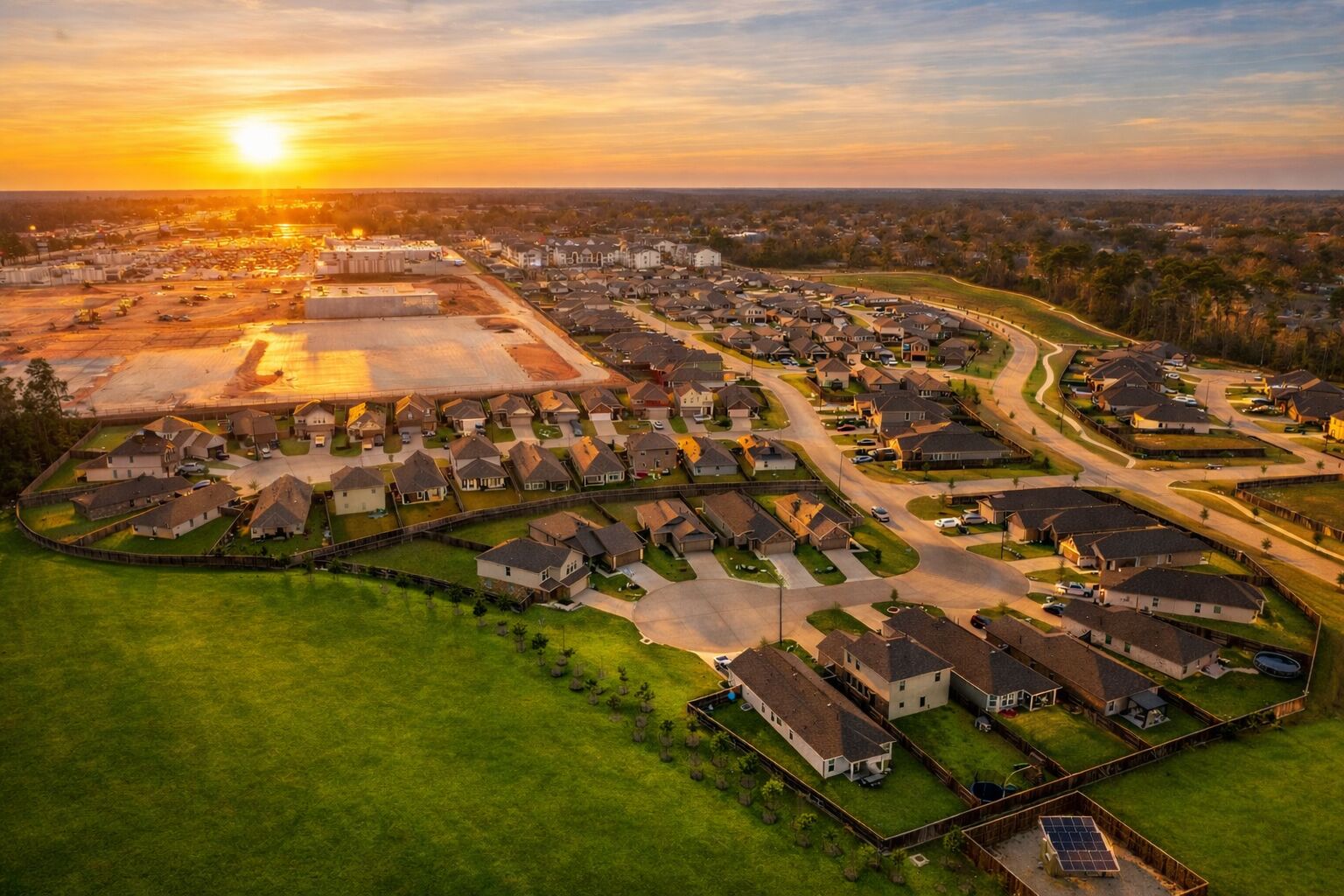
Because Houston has no traditional municipal zoning, most families and professionals gravitate toward master-planned communities outside Beltway 8 and along the Grand Parkway (SH 99). These communities provide deed-restricted neighborhood standards, resort-style pools, trail networks, and on-site elementary schools.
While Houston remains the Energy Capital of the World, its modern economy is heavily insulated by healthcare, aerospace, logistics, and manufacturing:
Newcomers should prepare for subtropical summers—where highs regularly sit in the mid-90s from June through September—paired with mild winters and occasional Gulf Coast storm systems. Because heavy rainfall and expansive clay soils are part of life on the Texas Gulf Coast, building standards matter significantly.
Modern new construction homes in Greater Houston are built to strict municipal windstorm and energy codes, featuring engineered post-tension foundations, high-SEER2 HVAC systems built for sustained heat, and community-wide detention ponds designed to manage stormwater runoff effectively. Explore how Whole Home Building Standards protect long-term comfort and energy efficiency in the Texas climate.
Houston's lack of pretension and unmatched cultural diversity show up best in its everyday lifestyle:
Whether you are relocating for a career opportunity, searching for a master-planned community with resort amenities, or looking to maximize your homebuying budget without state income taxes, Greater Houston offers a place tailored to your next chapter.
Ready to explore your options? Browse our new home communities across Greater Houston or view Quick Move-In homes available for your relocation timeline.
A Municipal Utility District (MUD) is a local government entity common in suburban Houston communities that funds water, sewer, and drainage infrastructure. MUD taxes appear on your annual property tax bill and gradually decrease over time as the community's initial infrastructure bonds are paid off.
Yes. With no state income tax and a median home price in the mid-$300,000s, Houston's overall cost of living sits roughly 5% to 8% below the national average—and significantly lower than coastal metros like New York, Los Angeles, or Seattle.
Top suburban destinations include Katy and Fulshear to the west, Cypress and Tomball to the northwest, The Woodlands and Conroe to the north, and Richmond and Missouri City to the southwest—each offering master-planned amenities and established public school districts.
What is a Mortgage Rate Buydown?

Home Inspections in Texas: What Buyers Should Know
By browsing, you accept our terms of use and privacy policy.


